ABA this week
06/07/26-06/13/26

Scholarly publications
Includes peer reviewed journals within and adjacent to behavior analysis
(Starred journals available to BCBAs through the BACB portal)
Behavior Analysis in Practice
6/8 Bottini, S., Kortanek, E., Rajagopal, S. et al. Guiding Principles for Researchers to Use Culturally Responsive Language in Publications: An Example Regarding Autistic People. Behav Analysis Practice (2026). https://doi.org/10.1007/s40617-026-01196-8
The authors argue for clear language informed by the target population
Cifuentes, J., Goyal, M. & Shawler, L.A. Effects of Antecedent and Consequence Secondary Targets on Intraverbal Teaching. Analysis Verbal Behav (2026). https://doi.org/10.1007/s40616-026-00229-1
(Open access) The authors compared secondary targets as antecedent and consequence stimuli, finding that either condition was superior to a control condition, and that ST as a consequence was more efficient
Behavioral Interventions *
6/8 Saral, Dincer, Seray Olcay, Kubilay Celik, and Halil Ozturk. 2026. “The Effects of Simultaneous Prompting and Choral Responding to Safety-Related Intraverbal Responding in Autistic Students,” Behavioral Interventions: e70117. https://doi.org/10.1002/bin.70117
3 preschoolers were taught simultaneously using choral responding to respond to intraverbal safety questions, and all students learned and maintained the skills
Perspectives on Behavior Science
6/9 Passarelli, D.A., Mizael, T.M. & de Rose, J.C. A Systematic Review of Empirical Data from Behavior Analysis on Anti-Black Bias. Perspect Behav Sci (2026). https://doi.org/10.1007/s40614-026-00506-3
(Open access) The authors identified 23 behavior analytic studies over 62 years that dealt with examining or combatting anti-Black bias. Relational tests like the IRAP show utility in measuring bias, and relational training has been effective with adults and children in combating racism; values clarification has been effective with adults. There is a need for more high-quality research
Behavior and Social Issues
6/10 Belisle, J., Sickman, E., Lopez, G. et al. Evaluating Complex Relations Within Social Class and Economic Inequality: A Translational Relational Density Theory Analysis. Behav. Soc. Iss. (2026). https://doi.org/10.1007/s42822-026-00253-9
Abstract symbols were shown to participants and trained to represent concepts “rich” and “poor.” The trainees showed a bias towards the symbol for “rich,” even when it came to abstract concepts like “trust,” representing how bias can form
Behavior Modification *
6/8 Portell, A. L., & Niec, L. N. (2026). Efficacy of a Brief Video Intervention to Improve Parenting Attitudes, Knowledge, and Use of Time-Out: A Randomized Control Trial. Behavior Modification, 0(0). https://doi.org/10.1177/01454455261449744
When shown a 2-minute video with accurate information about time-out from positive reinforcement, parent understanding increased, but attitudes toward time out did not change
Journal of the Experimental Analysis of Behavior *
6/7 Vitale, N. L., Lewon, M., Peters, C. M., & Hayes, L. J. (2026). Interactions between the effects of food and water motivating operations on concurrent food- and water-reinforced responding in mice. Journal of the Experimental Analysis of Behavior, 126(1), e70115. https://doi.org/10.1002/jeab.70115
Food, water, food and water, or control were tested as MOs. They each had different effects on behavior and on the strength of various reinforcers
6/9 Layton, K. L., Edwards, T. L., & Foster, T. M. (2026). An improved translational approach to studying persistence-strengthening effects of differential reinforcement of alternative behavior. Journal of the Experimental Analysis of Behavior, 126(1), e70117. https://doi.org/10.1002/jeab.70117
(Open access) In a translational study with hens, a traditional DRA reinforced alternative responding in the original context, with an alternative DRA reinforcing alternative responding in a new context, in order to test if the traditional procedure results in greater persistence of target behavior. This was the case
6/10 Drugan-Eppich, K., & Cox, D. J. (2026). Evaluating the combined effects of effort and probability on monetary discounting. Journal of the Experimental Analysis of Behavior, 126(1), e70118. https://doi.org/10.1002/jeab.70118
61 participants engaged in a hypothetical monetary discounting task that combined effort with probability. The general theory of discounting model fit best for most participants’ data
Education and Treatment of Children
6/8 Andzik, N.R., Pinczynski, M., Masud, A. et al. Board Certified Behavior Analysts’ Perceptions Regarding Roles in Serving Students with Extensive Support and Complex Communication Needs in Schools. Educ. Treat. Child. (2026). https://doi.org/10.1007/s43494-026-00184-5
Survey data plus 9 interviews with school-based BCBAs finds that BCBAs have experience with AAC devices, but very little training and guidance
Andzik, N.R., Perez, B.C., James, C.L. et al. Paraeducator Implementation of a Communication Intervention for Individuals with Significant Autism. Educ. Treat. Child. (2026). https://doi.org/10.1007/s43494-026-00185-4
The authors (with the same primary author as the other ETC article) trained paras to teach students to initiate AAC mands, but found that barriers include staff turnover
The Psychological Record
6/7 Rubio, A.R., Tomanari, G.Y. Molecular Analysis of Conditional Discriminations: The Sequential Pattern of Human Learning. Psychol Rec (2026). https://doi.org/10.1007/s40732-026-00690-3
(Open access) The authors tested for formation of conditional discriminations after each trial, finding that individual participants acquired the discriminations at different stages
6/11 Harman, M.J., Evers, Q. The Relationship between Subjective Time Perception and Measures of Delay Discounting. Psychol Rec (2026). https://doi.org/10.1007/s40732-026-00688-x
(Open access) 39 college students engaged in a time-estimation task, then a hypothetical monetary delay task. People who overestimated durations tended to discount more steeply, providing some evidence for an individualized effect of delay discounting
Journal of Contextual Behavioral Science
6/8 An Item Response Theory Analysis of the Self-as-Context Scale
Some suggestions to improve the self-as-context scale, including eliminating “neutral” as a response
6/10 A comprehensive psychometric evaluation of the Avoidance and Fusion Questionnaire for the Youth 8-item short form in a large sample of Finnish adolescents
The AFQ even works in Finland
6/11 Workplace training based on the ACT Matrix for Ugandan hospital staff: A feasibility and acceptability trial
(Open access) The ACT matrix and related training even works in Ugandan healthcare workers
Book publications
Textbooks, handbooks, manuals, or mass-market
Upcoming:
Nonlinear Contingency Analysis: Going Beyond Cognition and Behavior in Clinical Practice, Layng, Andronis, Codd, Abdel-Jalil (Eds.) (Nov 2026)
Case Studies and Applications in Nonlinear Contingency Analysis, Abdel-Jalil & Linnehan (Eds.) (Oct 2026)
Personal Narratives on the Behavior Analysis of Human Language and Cognition: Stories from Around the World, Harte et al. (Eds.) (Jul 2026)
WAVE Prosocial Assessment and Curriculum, Rehfeldt & Dixon (Pre-order)
Digital Technologies in Behavior Science: Theoretical and Practical Applications, Crone-Todd, Hantula, Layng (Eds.)
AIM Navigators, Dixon (Pre-order)
Promoting Language for Learners with Autism Spectrum Disorder: A Verbal Behavior Guide for Practitioners, Vladescu & Kissamore (Eds.)
Navigating Ethics in Behavior Analysis: Dealing with Gray Areas, Carr
Podcasts
ABA Inside Track
A Very Dual-Diagnosis Grab Bag (Summer 2026 Grab Bag)
Behavioral Observations
Beyond 80% Correct: Rethinking Mastery Criteria in ABA: Session 333 with Sarah Richling & Dan Fienup
Blogs
Generally these are produced by professionals
ABAI
Structuring Ethical Dialogue in ABA Supervision
Some guidelines with a hypothetical example
Knowing What You Don’t Know: A Student Guide to Competence in ABA
AI was used to compose this article and it shows
Lessons From My Two-Year-Old on the Power of a Language-Rich Environment
The lessons of Hart and Risley
Licensing & professional organizations
APBA
APBA Statement on recent media coverage of ABA
Not much to this statement
Business world
Autism services, behavioral health, etc.
With No Clear Market Leader, Clinicians Hold the Fate of the Autism Therapy Industry in Their Hands
Agree: fraud is not systemic and is in the hands of a small number of bad actors (though their fraud was enabled by systems)
Disagree: “No clear market leader” means that some company can dominate based on quality and make a lot of money – isn’t this attitude how fraud begins?
What in the: “But what the national media have shined a light on when it comes to dubious practices is a far cry from the out-and-out fraud that has been executed against the Minnesota public benefits system, which has been perpetrated by an international cabal of fraudsters exploiting their affinity with immigrant populations from Eastern Africa, according to the prosecutions of the U.S. Department of Justice.”
At this point why not insert speculation about covid-19 origins
Accidentally behavior analysis
A mainstream news article that relates to behavior analysis
IQ’s link to brain structure, function in children may be a mirage, The Transmitter
At minimum, we have known this for 30 years
Continuing education
UPCOMING:
BehaviorLive has free events: 6/23, 6/24, 6/25
Flashback
Tracking Skinner
The timeline is known, but here are some primary sources:
In 1942, he is engaged with Project Orcon/Project Pigeon, according to the University of Minnesota:

Then moving on to Indiana:

Though he was also completing a “manuscript” at the time –perhaps Walden 2?:

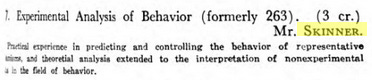
At Indiana, you could take experimental analysis of behavior classes with Skinner (as well as “verbal behavior” and “practical control of behavior,” with other classes taught by Kantor):
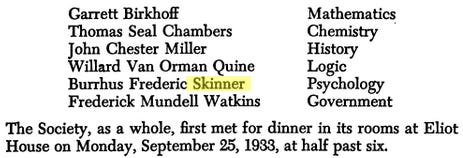
Then at Harvard he would become a “Junior fellow,” and if you really want to know what that means you can read all about it: