
Facilitated Communication and the red wine paradox
Are you the Rilke stan?

You are probably familiar with the incredible story of Oliver Sacks’ Awakenings, a 1973 nonfiction book that was made into a moderately successful 1990 film starring Robin Williams as Sacks and Robert De Niro as a patient named Leonard. Something is wrong with the story.
In a decade beginning in 1915, perhaps 1 million people around the world caught a disease, encephalitis lethargica, with a still-unknown etiology. A small number of those people became “frozen” – alive, but with little-to-no motor movement or speech. (This is a distinctly different condition from “Locked-in Syndrome.”)
In 1966, Sacks consulted at a “long-term residential care facility” in New York wherein he recognized that some of the 500 patients – up to 80, in his estimation – might have survived the encephalitis lethargica outbreak. And in observing their condition, he recognized similarities with Parkinson’s disease, a neurodegenerative condition, that was being treated with a drug called levodopa. The first peer-reviewed publication on levodopa in Parkinson’s arrived in 1968. Sacks began to treat his patients with levodopa in 1969. This was cutting edge – or rather, experimental – treatment.
The effects of levodopa were almost unbelievable: patients, unable to move or speak for up to 40 years, began walking and talking within days of starting levodopa. And not only that, but writing their names, dancing, and having conversations.
The bitter end to the story is that the drug quickly wore off, stopped working over time, and sometimes induced frustrating side effects such as tardive dyskinesia.
But a close reading of Awakenings would reveal problems.
A 2025 New Yorker profile by Rachel Aviv raises concerns with Sacks’ writing. The reporting used access to Sacks’ archives to confirm that, at least in some cases, Sacks was…what, exactly?
He was characterizing his patients, as a writer does. But his characterization was sometimes, charitably, fictionalization. An uncharitable person could easily call these lies.
Notably, Aviv writes about a patient from Awakenings called “Leonard L.” Sacks quotes Leonard using the poetry of Rilke, spelling on a letter board to compare himself to a caged panther. It’s a beautiful poem.
As Aviv notes, Sacks himself used the panther metaphor several times in his own personal correspondence, to characterize his own feelings as a closeted gay man.
Later, after treatment with levodopa, Leonard would write an autobiography. While encephalitis and levodopa were both understood to induce hypersexual behavior in some cases, Leonard’s autobiography includes several gleeful descriptions of sexual assaults that he committed as a young man.
Was Leonard a fan of Sacks’ favorite poet, by coincidence? Or was Sacks fictionalizing his patient?
Anna Stubblefield was a philosophy professor at Rutgers who threw herself wholeheartedly into Facilitated Communication, serving as a facilitator in her free time. She began working with a man, DJ, afflicted by cerebral palsy. While he had never spoken and had very limited control over his movements, with Anna’s help he began to spell words using a letter board.
Anna found that DJ could spell, despite a lifetime of special education. In fact, he wanted to become a writer. He loved poetry. And he liked red wine. Improbably, he enjoyed many of the same things that, say, a philosophy professor might.
But of course, that’s because the words he wrote were authored by Anna.
There are many people who independently use letters – a letter board, a keyboard, etc. – to communicate. But in almost all cases, FC messages are authored by the facilitator. This is perhaps due to a phenomenon called the ideomotor effect, familiar to anyone who has used a Ouija board. Skinner described a similar effect in Verbal Behavior as being responsible for “automatic writing,” which was sometimes attributed to various imaginary forces, like ghosts or the subconscious. Indeed, one of Skinner’s earliest publications (if you don’t count the poetry he wrote at 15) was an Atlantic piece regarding Gertrude Stein’s automatic writing.
Anna Stubblefield surely did not know she was the sole author of DJ’s communication. She couldn’t have known because she believed that she fell in love, and began a relationship that caused her to be arrested, tried, and convicted of abuse.
It’s true that she fell in love, but she fell in love with communication that originated with her. She fell in love with herself.
Facilitated Communication has failed scientifically. It has even failed on television, in an excellent episode of PBS Frontline from 1993.
The debunking is rather simple: show a picture to the facilitator and to the communicator. In some cases, the image will be the same, while in others the image that each person sees is different. In all cases, the communicator types what the facilitator sees – even when the communicator didn’t see it. There is a reenactment of this process in the Frontline episode, as well as several peer-reviewed experiments to this effect.
If you’re more of a book reader, there’s a comprehensive chapter devoted to FC in Controversial Therapies for Autism and Developmental Disabilities.
Still, it persists as a strange cultural artifact. FC has been repackaged and resold as rapid prompting. It has been credulously rediscovered in a mainstream podcast, fittingly entitled “The Telepathy Tapes.” There are even books “written” via FC.
What is left to debunk?
The most surprising aspect of Facilitated Communication stories is the homogeneous mainstream striving of most communicators.
Set aside the myriad other problems: they want to go to college, write books, get married. They quote Rilke and develop a taste for red wine.
Nobody wants to type about trains or buses? Not one expresses a desire to transition? None want to be a YouTuber, or play video games all day? Not every communicator is autistic, but are they all so…neurotypical? (Lest you think we exaggerate, here is an example of 8 qualitative interviews, with the interviewees mentioning dating and friendships. While these are a common human experience, it is remarkable how conventionally the sentiments are expressed.)
Why is every communicator a secret poet?
Woody Brown is a published author, with an interesting backstory. He is an autistic man with a limited vocal repertoire, and he communicates via FC. His mother has a master’s degree in English literature, and she serves as his facilitator. It’s a fortuitous coincidence that Woody wanted to be a writer.


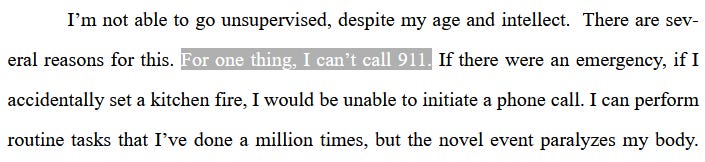
The first chapter of his 2026 book about an adult day program, Upward Bound, includes references to Charles Dickens and the Carter administration, as well as an admission that, despite “typing” with FC, he can’t dial 3 digits on a phone (?).
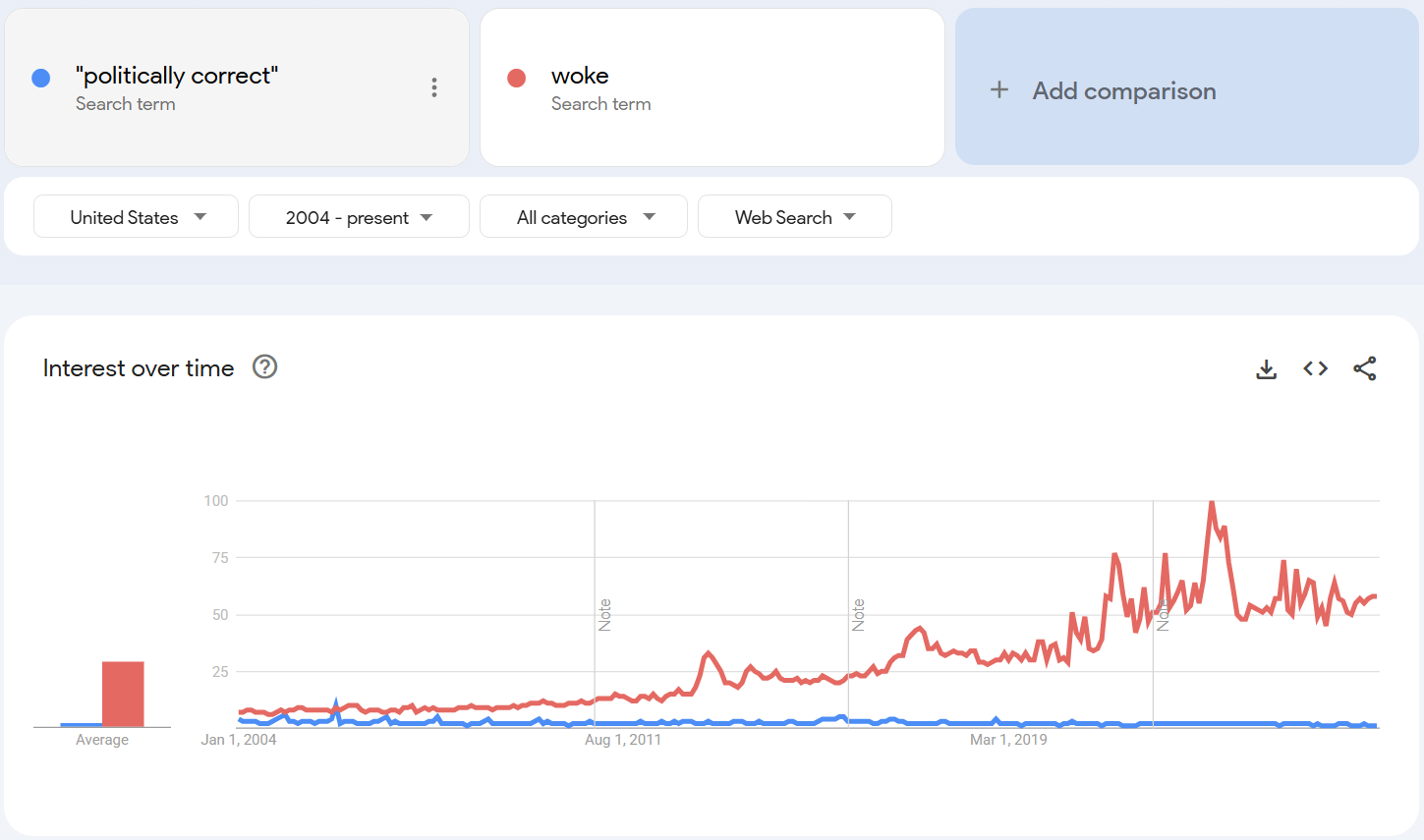
A later chapter refers to “political correctness,” a concept that, let’s just say, has been overshadowed for nearly the entire lifespan of one Woody Brown:
The second chapter of Upward Bound is about Tom, a man with cerebral palsy. The chapter describes his inner monologue, his dreams, his hopes. There’s an aside that Tom has no method of communication.
It is, strictly speaking, fictional.
Nice work, ‘Fred!’ Sometimes when things seem _incredible_, that is because they are incredible.