

It is 1930 in mainland China.
A bank of cages is filled with kittens. A man peers into a cage. The kitten inside paws the door. The man spoons cooked soybeans into a slot, where they drop under the kitten’s nose.
In the same cage, a small gray rat huddles in the far corner.
The kitten approaches the rat. The rat hardly moves.
The kitten opens its mouth slightly. She licks the rat.
This is grooming behavior. The kitten and the rat have been raised together since birth. The kitten, up to this point, has never observed another cat attacking a rat. And this kitten will never attack this rat, or any similar rat. This kitten has been made into a rat-lover.
Zing-Yang Kuo maintains that this is his strongest argument yet for the complete abolition of the concept of “instinct.” By this point, he’s been making that case for nearly a decade.
Zing-Yang Kuo was born in 1898 into a China we would scarcely recognize. Having recently been defeated in war by Japan, there was an attempted reform aimed at modernizing politics and culture, followed by a coup d’etat. Modernization was a goal because China was largely impoverished and rural. Political unrest would roil mainland China for decades.
Kuo (whose name is perhaps more accurately transliterated as Guo Renyuan) was born into wealth. While his published writing doesn’t expound on his childhood, some anecdotes characterize him as intelligent, rebellious, and privileged. He briefly attended college in China, then travelled to the United States to study at Berkeley. In the 1920s, this would have been prohibitively expensive for most Chinese citizens. Emily Baum claims that Kuo’s unpublished autobiography states that his father was in the opium trade, but this is unconfirmed.
By 1921, Kuo published a paper near the end of his undergrad studies. Entitled Giving Up Instincts in Psychology, it sparked at least 7 responses over the following 12 months. It’s easy to see why: Kuo takes the stance that the concept of instinct should be abandoned entirely. (He also sparked an academic debate in China, but these articles were not generally accessible to Americans at the time)
Kuo’s eventual perspective, refined over 40 years but remarkably similar to this first paper, is that organisms of one type have the same general physical properties, but are influenced by their environment, both physical and social. So while genetic potential is similar, all behaviors are shaped by the environment.
An illustrative example: birds fly. Is this instinctual? Douglas Spalding in 1875 kept birds in cages wherein they could not spread their wings, and never observed other birds in flight. Still, when released at the age of which birds typically fly, these birds also flew. Spalding thus concluded that this was instinctual.
Decades later, Kuo ran a similar experiment. Birds raised in a similar fashion did not always fly when released into a large enclosure. In fact, many of the birds simply hopped along on the ground. But when threatened – when a dog entered the enclosure – most birds did fly. Kuo maintained that most birds can fly, but tend to do so only with environmental pressure.
And even still, as Dennis points out in a 1940 replication of Spalding’s experiment, birds restrained from flying do not have typical flight on their first attempt. Indeed their flight is rudimentary and only improves with practice.
Flight is a complex coordination of musculoskeletal movement – what we might call operant. What about something simple, such as pecking?
Kuo posited that pecking movements developed over time. They just started developing before we could see it: inside the egg.
After perhaps hundreds of experiments, he discovered a reliable system. He cut a portion of the top layer of shell off of an egg, keeping the membrane intact. He covered the exposed membrane with petroleum jelly, using a calligraphy brush. This allowed the embryo to develop essentially as normal, with a “window” into the egg. At this point in history, there had been no reliable way to observe the complete development of a bird embryo.
Pecking did not arrive, fully-formed, as a reflex or instinct. It developed slowly, within the egg. Indeed, Kuo regarded hatching merely as a change in the environment.
What, exactly, is the problem with instinct?
As Kuo saw it, the main problem is that calling any behavior an instinct precludes further scientific investigation, and pretends to be explanatory.
How does the behavior develop? It’s an instinct. This is, even today, accepted as a complete explanation.
Further, it presupposes that an instinct cannot be influenced by biological or social pressure. But as Kuo points out, cats can hunt or love rats – which is instinct? Perhaps the biological potential of organisms, while similar at the population level, is much more extensive than previously considered.
Kuo might have regarded the events of his life as distinctly unironic: after all, the physical and social environment shaped him. At several points in his writing, he cites “the political situation” in China as reason for his failure to complete research – eliding the fact that, in his lifetime, this included the Boxer Rebellion, invasion by Japan, the Sino-Japanese war, the Russo-Japanese war (which, despite being a war between Russia and Japan, took place in China), communist revolution (which did not technically end for years after it “ended”), living in what was officially a British colony, and shortly before his death, the cultural revolution. This was the set dressing.
He was undoubtedly hard-working and brilliant, but as quoted in Blowers, Carmichael noted that his English was not good enough to be considered for a teaching position in America. Another anecdote regarding his 1967 book, The Dynamics of Behavior Development: an Epigenetic View, is that his American editor significantly revised the language. To our knowledge, there is no extant audio or video of Kuo; was this concern about his English ability justified, or bigoted? In any case, he returned to China after studying at Berkeley. He had completed a PhD thesis, but refused to incorporate any committee feedback, and was not granted a doctorate degree.
In mainland China, Kuo began a teaching position in a university, at a time when there was no psychology department. Kuo’s wealthy familial connections led him to be a serious fundraiser, so much so that he was responsible for the construction of a large Western-style building, housing the brand new psychology department.
And here, Kuo’s life took a strange turn. He took a position overseeing an experimental middle school, including the curriculum. But the brilliant, politically savvy scientist quickly became unpopular. He was strict, punitive, and inspired a student rebellion. A student rebellion in a middle school.
Years later, when given the opportunity to become a university president, a remarkably similar situation occurred.
The communist revolution was in its infancy. Kuo was anti-Marxist – as quoted in Baum, because “Marxism is not revolutionary enough.” But communism was popular with students. When students planned to travel to a distant protest, Kuo informed the government. The students were unharmed; they were merely stopped and sent back. Still, it was an immensely unpopular move and after an extensive student manifesto was published in a newspaper, he was asked to step down.
Kuo traveled America for 9 years, visiting various universities to conduct research and to officially lobby for greater cooperation between American and Chinese institutions. Both missions resulted in failure: Kuo was, again, not offered a professorship in America, and his push for cooperation was met with skepticism.
Kuo returned to China, but soon left the mainland, living the majority of the remainder of his life in Hong Kong, and largely outside of academia. (He lived in Kowloon, though unfortunately for us, not Kowloon Walled City). He returned briefly to America at the behest of Gilbert Gottlieb, and in 1963 helped guide some of Gottlieb’s research. (Some of Gottlieb’s brilliant research includes an experiment that showed that prenatal exposure to different calls can cause ducks to prefer chicken clucks over their mother’s quack)
In the final years of his life, he was working on a book about the “national character” of the Chinese people.
Blowers writes provocatively about Kuo’s final, unpublished book. The title says it all: Was ZY Kuo a Radical Behaviorist?
After all, writing an entire book aimed at characterizing the population of China – it seems distinctly mentalistic. Ultimately, Blowers concludes that Kuo was not strictly a radical behaviorist.
Our own perspective is that it seems that Kuo made a distinction between humans and animals. The failure to apply his own basic scientific principles to working with students; the book on “Chinese national character”; a lack of applied research with human subjects; it all points to a common opinion that “humans are different” (and perhaps they are).
Ultimately, “Kuo was not a radical behaviorist” might be true – but it is not exactly a damning criticism.
But what about the suggestion that he – and that behaviorism – is fascist?
Emily Baum wrote a well-sourced, thorough, and occasionally misguided 2015 profile of Kuo.
She misinterprets his work in his 1967 book The Dynamics of Behavior Development, leading to a fatal flaw in her argumentation. Kuo admits that heredity is important in behavior, but he does not “retreat from behaviorism,” as Baum phrases it. As an example, Kuo notes that a horse can neither fly nor talk – the physical reality of an organism constrains its behavioral potential. He does not materially change his argument regarding the influence of the environment on potential.
1967 version, p 199

She claims that “social control” fell out of fashion due to Nazi Germany, with the implication that Nazi eugenicism has some type of overlap with Kuo’s philosophy. The obvious conflict is that Kuo had been the strongest proponent of an anti-instinct movement that is characterized as distinctly anti-hereditary. Kuo denied the very possibility of eugenics. Indeed, from A Psychology Without Heredity:

And importantly, Baum claims that Kuo’s “administrative tactics were reinforced by laboratory experiments.” While behaviorism was in early stages in America, and even more so in China, this is a fundamental misunderstanding of the literature. It is our opinion that Kuo, again, abandoned science when working with people. Because if his tactics were, in fact, “reinforced by laboratory experiments,” what were they? Based on chicken embryos?
However, returning to Kuo’s politics. The way he tried to run two different schools – a single strong authority, revolutionary but anti-communist, harsh rules – it certainly appears fascist.
Which leads us to an uncomfortable truth.
Behaviorism, as applied to the betterment of society, has a passing resemblance to fascism.
Kuo, and even Skinner, could appear fascist to certain people.
Firstly, this is – at least in part – because it is difficult to define fascism. But examine some of the definitions in the previous link, and you might notice that the primary similarity among definitions is a strong leader. Critics see a single cultural designer as fascistic.
In a deliberately scientific design of an environment or culture, it is perhaps unavoidable to have a small number of experts at the helm. Skinner himself wrote, in News From Nowhere (in the voice of a character):
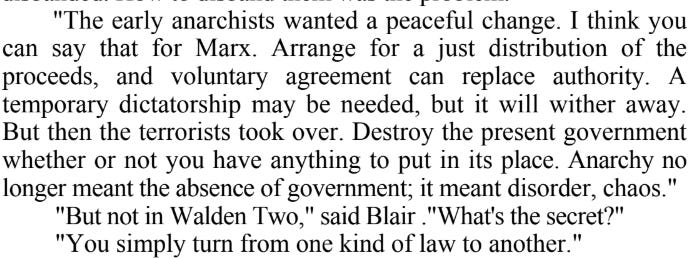
A temporary dictatorship! However, it’s clear that Skinner is calling for a form of anarchy. Indeed, when designing his ideal society in Walden Two, he does not call for a dictatorship. Examining definitions of fascism, we see other qualities that are distinctly not behaviorist: centralized capitalism, strong nationalism, rigid social hierarchies, etc.
Kuo did, until his “exile” to Hong Kong, consistently push himself into leadership. He jockeyed for administrative roles in schools, lobbied for political appointments, and worked connections at American universities. Would he have been some kind of “benevolent” technological dictator if he had ever gotten the chance?
It’s not clear, but it seems that he wanted to run schools in that fashion.
And so: perhaps, as Blowers puts it, Kuo was not a radical behaviorist.
Is Behaviorism fascist? I was hired to help a group of special education teachers at San Diego City Schools. San Diego was involved in DI during Project Follow Through. I arrived years later. I discovered that the district had placed all the DI curricula in storage. Teachers were not permitted to use the curricula without special permission. I was told DI is Fascist. Its use was discouraged. Nevertheless for my work there I was permitted to use the curriculum. DI is Fascist, who knew?
I enjoyed reading your article. Learned something new. Some time ago you reported research that suggested RNA could transmit (?) learned behavior from the organism's 'mother' to the animal's offspring. The animals offspring would be predisposed to learn the behavior (s) faster than other similar organisms without the RNA influence. Could that be partially the reason why birds make nests without direct instruction? An explanation for instinct?