
The most common VB-MAPP mistake
And what to do about it

If you are reading this, there’s a good chance you’ve used the VB-MAPP assessment. We won’t belabor a definition.
For a developing learner, some skills are prerequisites for learning itself. For example, to learn from another person, a learner needs to look at a teacher or their materials, imitate motor movements, and repeat words.
Some kids do not easily learn to repeat, also known as echoing. A Speech-Language Pathologist, Barbara Esch, created the echoic assessment portion of the VB-MAPP, known as the EESA (Early Echoic Skills Assessment). There are 100 targets, starting with sounds, proceeding to simple words, then small groups of words.
Frequently, practitioners use the EESA by assessing targets, later repurposing assessment targets as program targets. For example, if during the assessment the child hears “ah” and says “mah,” the assessment sound “ah” could become a program target for that learner.
Just one problem:
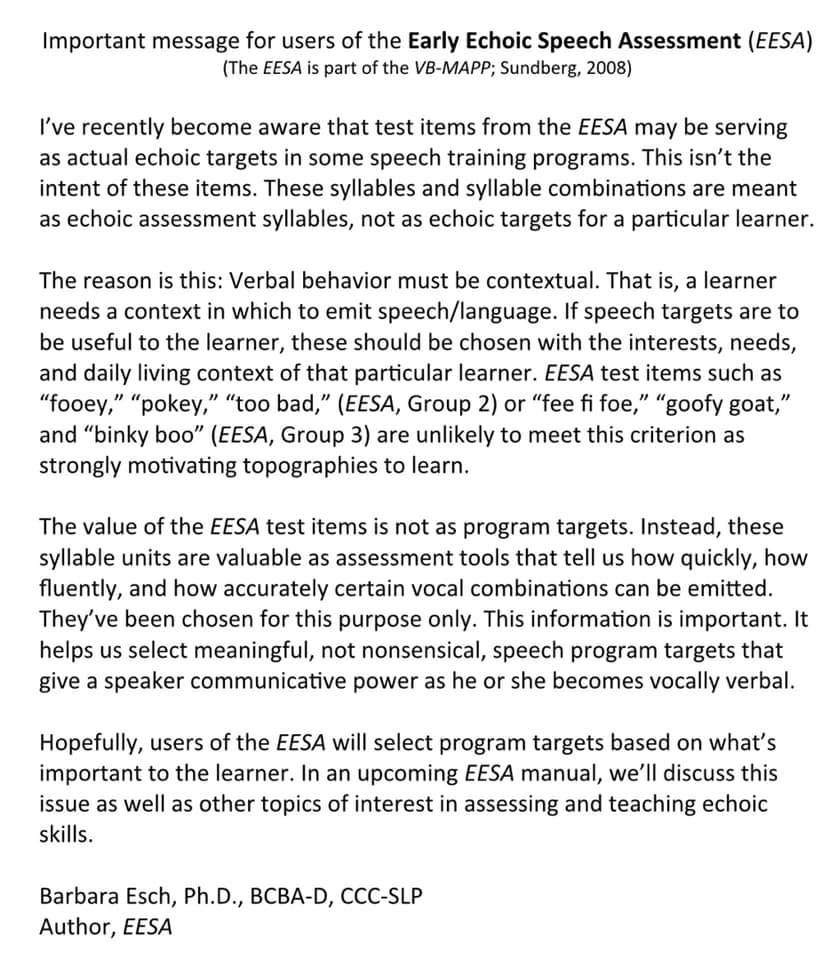
So, the issue here is that the assessment items are supposed to be a starting point to find a suitable meaningful echoic target for a learner. For example, assessment target “ah” is not meaningful by itself, but “off” – with the same initial sound – could be important to a learner who likes turning the lights off.
It makes sense: maybe we’re not that interested in making kids say “goofy goat.” But it does lead us to wonder what we’re supposed to do.
The VB-MAPP, as near as we can tell, does not provide direction in the instructions manual or in the assessment booklet.
Before we introduce our solution, we wanted to note that in researching this piece, we came across Barbara Esch’s extension of the EESA, the EESAPP, which is $150 and which we have not evaluated. Let us know if you’ve used it, and what you think.
The Stanford Wordbank is a database of results from parent surveys on what children of varying ages and languages actually say. The words can be sorted by percentage of kids that have acquired it by a certain age.
For example, here is part of the page for one survey measure (Words & Gestures) of American English-speaking kids from 12-18 months, sorted by percentage of kids that say the word by 18 months:
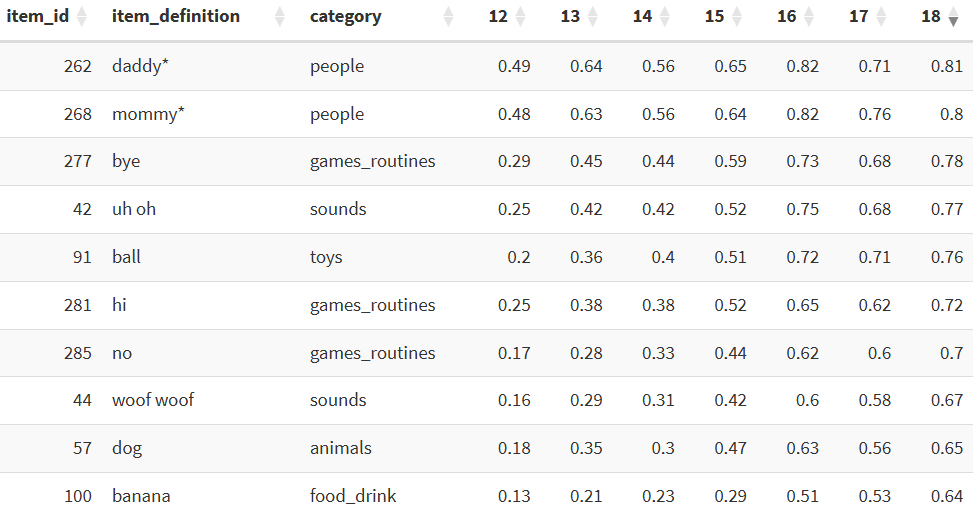
About 80% of 18 month olds say “daddy” and “mommy,” about ¾ say “ball,” and more than half say “banana.”
These would all be great echoic targets for some kids. Note that there are no “nonsense” type word combinations, such as “goofy goat” – even a target like “woof woof” could be a meaningful target to a kid who loves dogs.
Additionally, there are 396 words in this search. Other languages are represented, including Spanish. If you want to be sure of the social significance of, say, “woof woof,” here are first words across several languages (with common items in bold):
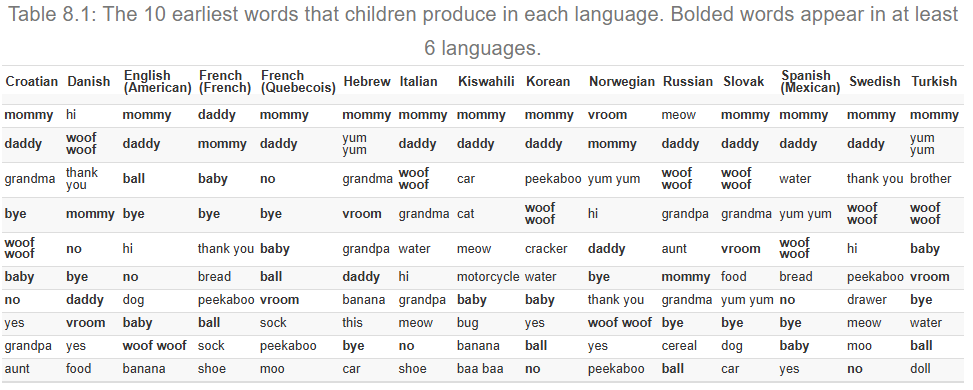
Common words across languages imply that these are easy to pronounce and socially significant, at least for most kids.
Where might we start with a beginning learner? We could easily start with the top 10 words in this list, which includes people, sounds, toys, etc. However this is a parallel problem from Esch’s complaint: the target words could be meaningless to the learner. As but one example, teaching “daddy” might be a poor target for a child being raised by a single mother.
Every learner needs at least some unique targets. But let’s add some guidelines.
Sundberg & Partington’s book, Teaching Language to Children With Autism or Other Developmental Disabilities, is mentioned by Sundberg as the place to find methods for teaching. Some of their tips follow. If we start with a child who makes very few sounds, and perhaps doesn’t echo, we can directly reinforce any sound made by the child. Additionally, the adult can make sounds while providing putative reinforcers (known as stimulus-stimulus pairing); for example, if the child appears to like tickles, the adult can make a consistent sound each time they tickle. You can also try to get a child to repeat a sound they make already.
If a child is just starting to echo, you could move on to vowel sounds. Once you have temporal control (e.g., the child typically attempts to echo the model when motivation is in place), you can assess with the VB-MAPP.
In the initial level of the EESA, the following skills are specified: “vowels, diphthongs, consonants p, b, m, n, h, w.” If we analyze the skills, we can find the minimum number of examples that fulfill all skills and are words that are commonly acquired. Here is an example that covers the aforementioned consonants, vowels, and approximately all diphthongs (there is some overlap in sounds) in a total of 14 targets:
EXAMPLE Level 1:
No (N, diphthong)
Bye (B, diphthong
More (M, dipthong)
Hi (H, diphthong)
Peek (P, diphthong)
Ouch (W, dipthong)
Baby (B, dipthong)
Moo (M, diphthong)
Toy (diphthong)
Daddy (vowel)
Mommy (vowel)
Yes (vowel)
Milk (vowel)
Uh oh (vowel)
These would need to be changed for social significance.
Level 2 adds two syllable words, plus “consonants k, g, t, d, f, y, ng.” That’s 8 diphthongs, 5 vowels, and 7 consonants.
EXAMPLE Level 2:
Apple (P, vowel)
Balloon (B, diphthong)
Meow (M, 2 diphthongs)
Night night (N, diphthong)
Hello (H, vowel, diphthong)
Water (W, vowel)
Kitty (K, vowel)
All gone (G, vowel)
Turtle (T, diphthong)
Down (D, vowel)
Flower (F, vowel)
Yum yum (Y, vowel)
Swing (ng, vowel)
Play (diphthong)
Boy (diphthong)
There were a few challenges with this process.
You might notice we didn’t tackle level 3 – because the process for finding words at level 1 & 2 took a few hours. Even if you have the EESA guidelines and a resource like the Stanford Wordbank, you could spend considerable time for each learner just on echoics (though presumably this would improve with practice).
Additionally, there are limitations with the words themselves. We attempted to loosely stay within the first 100-150 words learned by 18 months on the WG list. Still, few words appeared with the “oy” and “ay” diphthongs. “Toy” is past 150, “boy” is past 250, and “play” is past 200. Frankly, the placement of these words implies that they could be more challenging to acquire, and thus they may not be appropriate targets.
Ultimately it can be a frustrating experience: people often aren’t aware that they’re not supposed to use the assessment targets as program targets; but if they are aware, they often don’t know what to do instead; but if they do know what to do, it is challenging, time-consuming, and other practitioners may not be able to confirm that good targets have been chosen.
When it comes to certain skills, there is less of a focus on individualization. For example, Direct Instruction programs like DISTAR or Corrective Reading can be used to teach most kids to read. Perhaps we will one day have a more standardized curriculum for developing echoics.
Until then, good luck with your spreadsheet.